Allready set a bookmark?   |Mendocino-Motor|

Twitter Facebook Google Mail Fav


Preface

 
The Mendocino motor is a solar-powered magnetically-levitated electric motor.


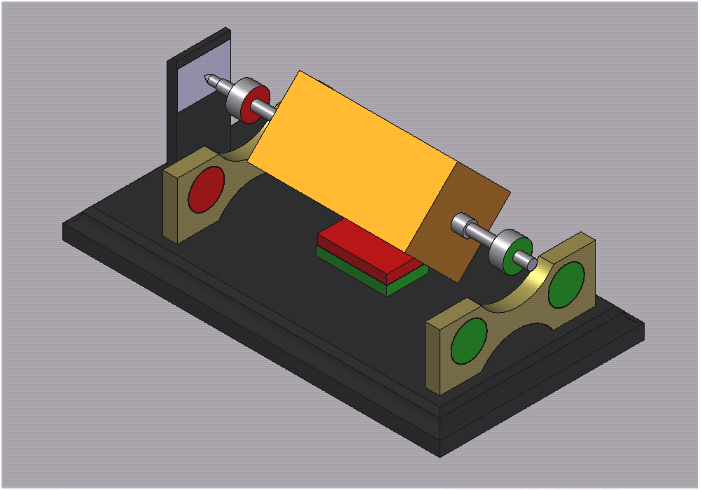
Schematic construction - Mendocino Motor

 
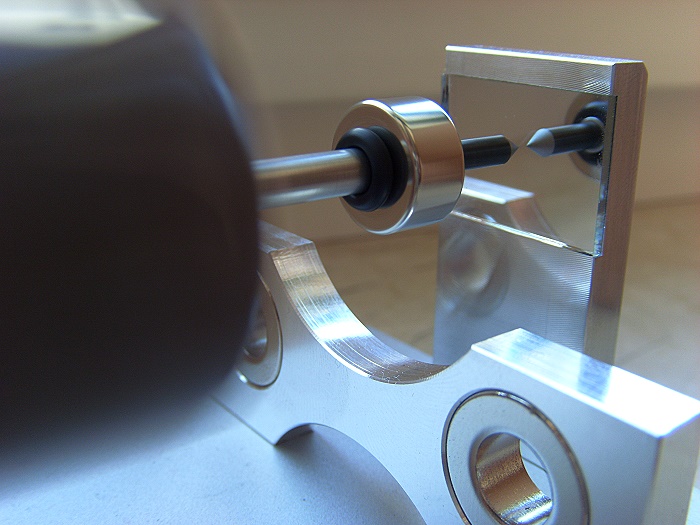
Schematic construction of the Mondocino - Motor: The both colors red and green are symbolize for the poles of the magnets. Red for the North Pole and green is the South Pole. The round magnets are for the levitating and the square magnet for the rotation. The rear brace is holding the rotor. For a very low friction is the shaft end taper to a point (HSS-drill) and goes on a mirror.
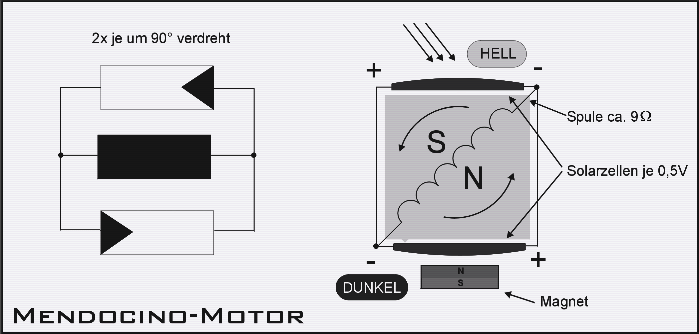
The schematics of the Mendocino - Motors: Altogether we have four solar cells arranged in a square. The upper cell shows to the light and the opposite (downsite) shows in the shadow. We have two cells connected in series. It looks like mysterious because there will be have a short circuit. Practice has shown that is functional. It´s always one of the both cells go into action and it build up a voltage. The cell in shadow site is closed and a current will flow over the rotor winding. We turn the rotor to the opposite (180°) and this coil have a reversed polarity. This produced magnetic field which interacts with the field of the magnet under the rotor. This interaction causes the rotor to turn. As the rotor rotates, the next solar cell moves into the light and energizes the second winding. This process repeats as the motor spins.

In my example I have used solar cells (65x20mm) with a half volt output and a current of 250mA. The strength of magnetic field (Durchflutung / magnetomotive force) is the product from the number of turns in the winding and the current in the wire. For a "high" electricity flows we need a "thicker" copper wire.

I used a coil with 100 windings and a thick from 0,22mm (lacquer-coated wire). The resistor is 9 Ohm. The current, a product of, voltage (V) and resistor (R): I=V/R = 0,5/9 = 55mA and that is enough. That ist what we need as a minimum for your solar cells. My cells have 250mA at sunlight. Unfortunately, the power goes down with decreasing sunlight. For that reason we need any reserves for it.
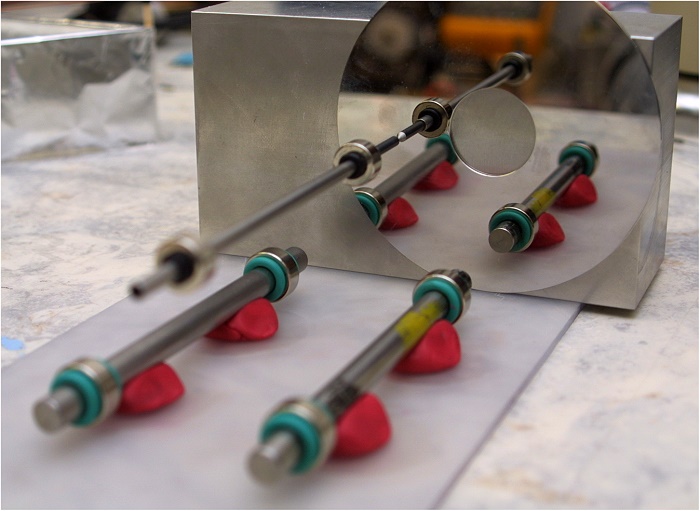
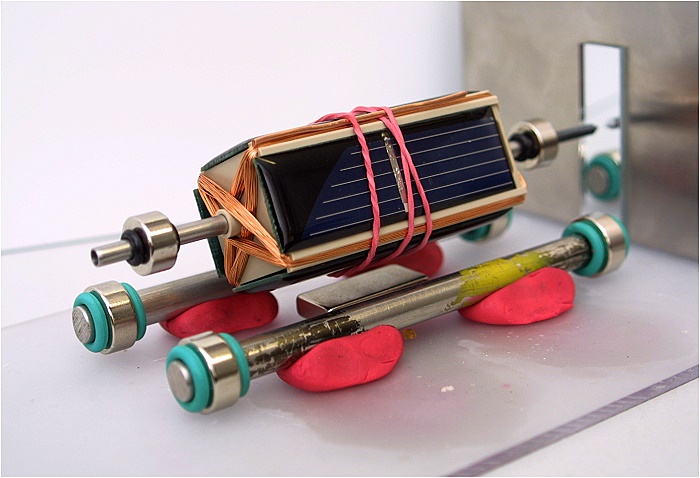
Here my first try to levitate. All magnets are neodymium-magnets.
 
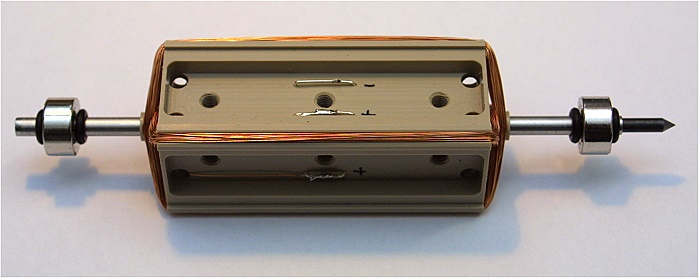
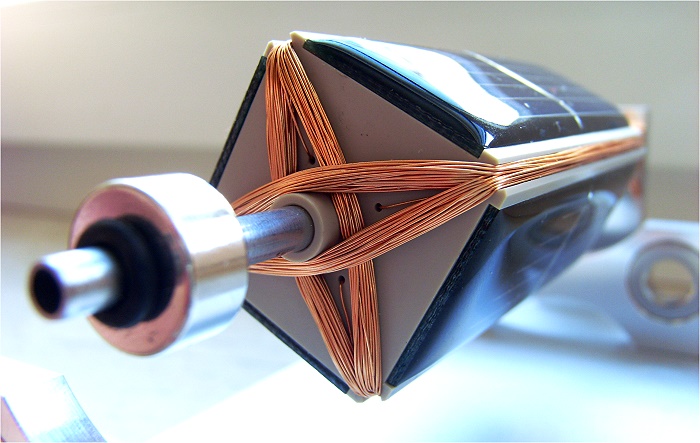
Now the motor armature on the shaft: The silver wire go through the shaft to connect the solar cells. For balancing it i made three tapped holes for grub screws. So it´s possible a fine adjustment.
 
So let's go and check out if their all be ok? On the top you can see a very thick copper wire it´s also to balancing the rotor. I never believed that the weight of the cells are so different.


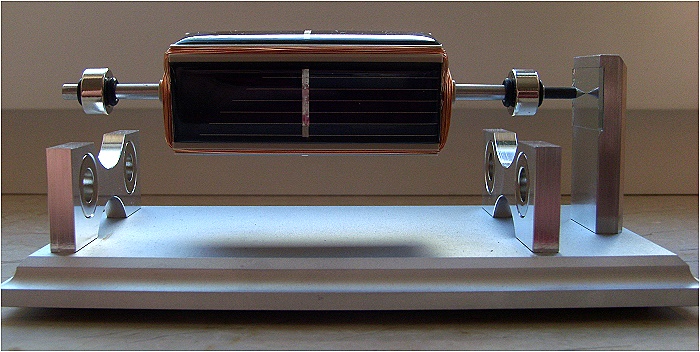
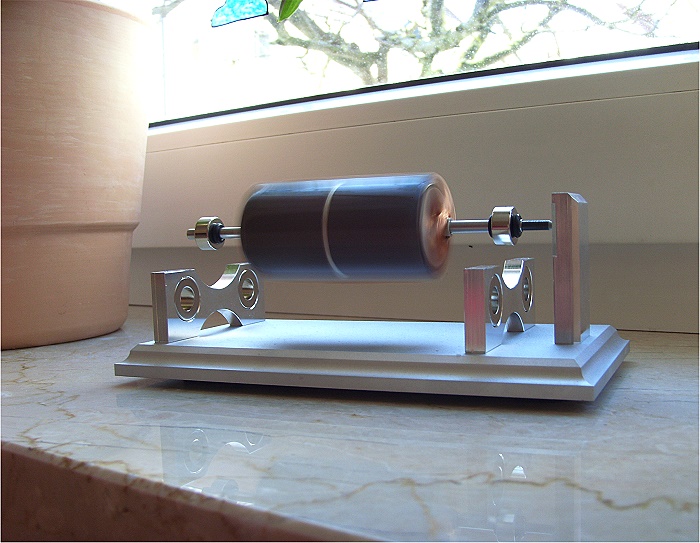
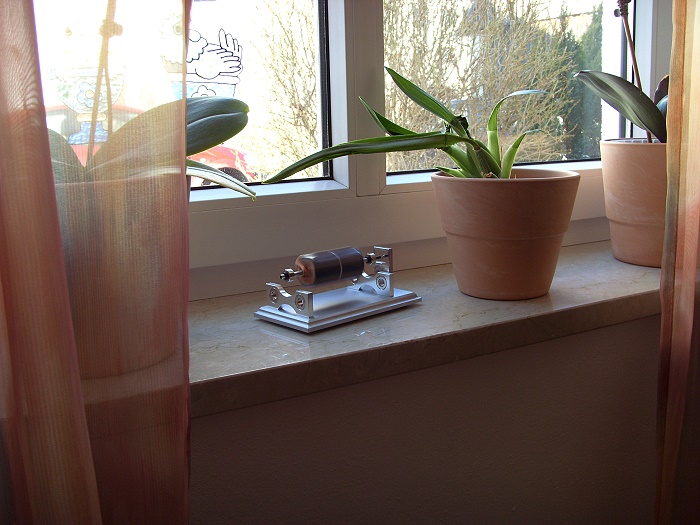
And finaly the Mendocino - Motor on my windowsill.
 
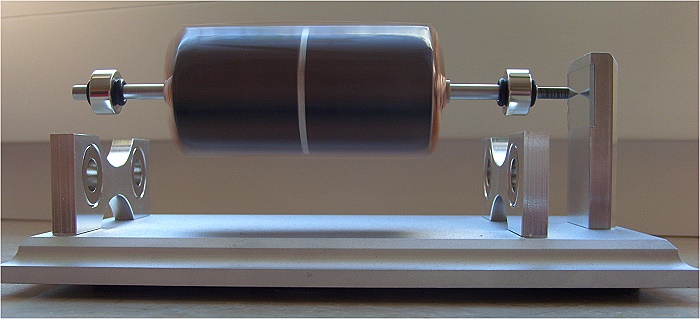
Now running.
 
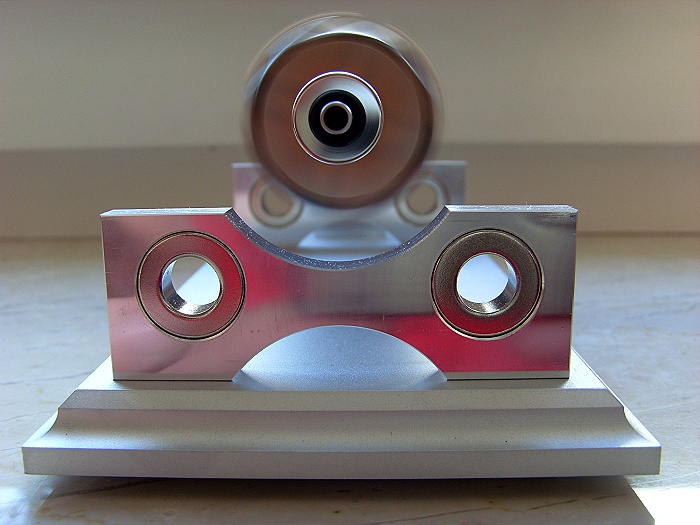
The frame is milled from aluminium and screw connected.
 
Here you can see how the wire goes to the mount inside.
 
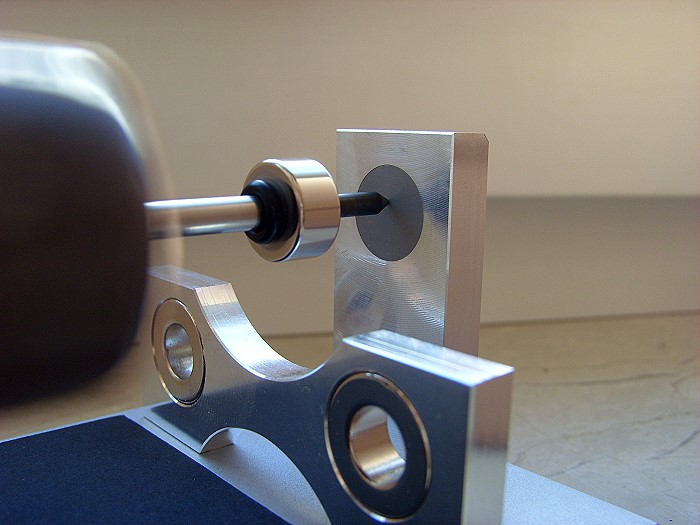
On the opposite the mirror for a low friction. The mirror is glued to the brace.
 
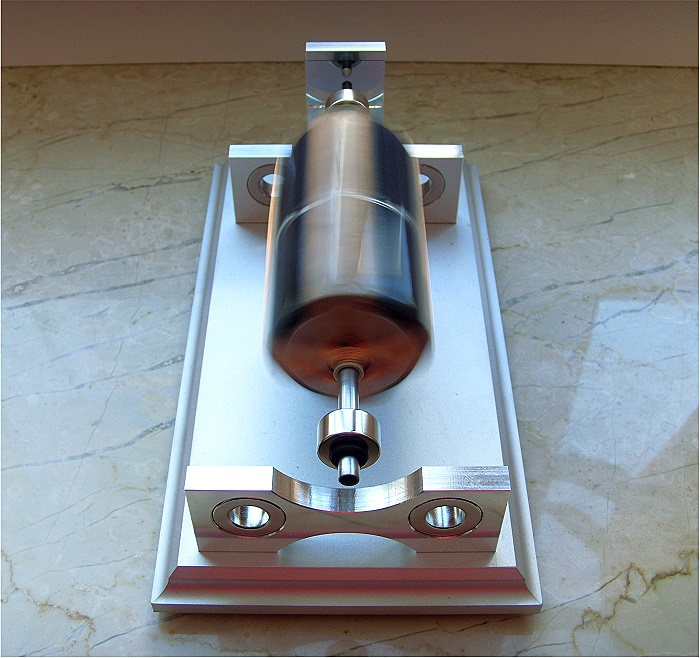
Top view.
 
With flowerpot.
 
And now with two flowerpots :-)


Version 2

 
I am sorry to say that, so far, the tip of the shaft has bored into the mirror. These lead to a deterioration of the running properties. In the weak light the mondocino motor can´t start to run and in addition it started to reel.

Conclusion: First my mirror had to be removed and must be replaced by a very hard material. I found a ceramic indexable inserts (Polycrystalline Boron Nitride Indexable Inserts - PCBN).

The most mendocino motors has a mirror to hold the rotor but there use ballpoint refills. This is much softer than my 3mm HSS-drill. It remains to be seen how it work.

Supplement : Half a year after, the motor is always running. It´s nothing to see on the PCBN ;-)


Video      My channel on YouTube


Allready set a bookmark?   |Mendocino-Motor|

Twitter Facebook Google Mail Fav


Comments and questions (21)


  • Comment by Gilbert Bouquet 29.03.2012, 18.31

    Uoy have built a very nic motor! I also made one and it runs fine, but now and then there is an oscillation in the shaft. If I have bad look, the rotor falls. Do you have any idea how to prevent that? Thanls

    Answer: Try to change the magnets on the shaft. Not all magnets have a uniform magnetic field.


  • Comment by karthi 22.03.2012, 05.48

    Hi,
    how do you connect the windings with the solar cell

    Answer: All infos find you at the schematic.


  • Comment by Greg Garriss 05.03.2012, 20.31

    Truly a machine of sublime beauty. Thank you for posting your work. I can hardly wait to build one.

    Answer: Thank you very much.


  • Comment by George 14.02.2012, 10.32

    Thanks a lot man!


  • Comment by Ronald 12.02.2012, 16.44

    Hi,

    Your Mendocino Motor is just awesome. I was wondering if you have a shopping list for the parts that you used, so that i can just buy them from the internet. Or maybe I can buy them from you? I can't seem to find the magnets online.

    Answer: Thank you, no i don't have a shopping list and I sell nothing. All magnets can you find by www.magnet-shop.net (shaft RM-12x04x06-N and the bottom RM-15x08x06-N)


  • Comment by George 08.02.2012, 12.46

    I'v search on internet, but i can't find any cell match your description, can you help?
    all the solar cell that i find for 250mA is double side then yours. and the power in V is 7.5V, and 250mA.
    Can you give me some advices refer to the solar panel??
    Tx!

    Answer: Searching to "0.5V250MAH MONOCRYSTALLINE SOLAR PANELS" on ebay. I have it from Great Britain.


  • Comment by Hari 02.02.2012, 15.00

    what type of magnets have you used??

    Answer: Nd2Fe14B


  • Comment by Keith 29.01.2012, 06.16

    Guess I'm waste'n my time asking questions here.

    Answer: Don't panic. I don't understand your question. I have two coils and every coil has 100 windings. Every of this is set in the diagonal of the armature. I hope your question is answered.


  • Comment by Keith 22.01.2012, 04.23

    Does Wrapping the motor with the magnet wire involves carefully wrapping the wire in the grooves around the block 100 times in sets of ten alternating on each side of the dowel ?


  • Comment by Igor 08.12.2011, 21.49

    Thank you for this great site. It really helped me a lot.

    I just have one question. Is it possible to use 8 magnets in base and have it completely levitating?
    Instead of 2 have rotor magnet suspended between 4 magnets in the base on each side. And eliminate vertical stopper thingy.

    Sorry for bothering you with this. I would test it myself but I don't have magnets and they are very expensive in Serbia where I live. And I wouldn't want to buy more than I need.

    Thank you very much in advance.

    Answer: Unfortunately it is not possible.


  • Comment by John from Australia 02.12.2011, 02.39

    Great Job on the Video and the Project is brilliant,
    I was wondering if maybe you had a couple of Neo Magnets arranged so as to eliminate the "wear factor" on the shaft end?,perhaps by placing a small round magnet affixed to the upright and another fixed to the shaft end with both ends setup with reversed button magnets so as to suspend the shaft between them? maybe ?.
    Keep up the great work and thanks for all the effort you've put into tis presentation.


  • Comment by John Hubbard 12.10.2011, 21.09

    Also, the machine work is excellent as well.


  • Comment by John Hubbard 12.10.2011, 21.08

    Beautiful explanation and diagrams/pictures. Thank you for going to all this trouble.


  • Comment by deiv 01.10.2011, 14.57

    how many RPM it may do ?
    great project !


  • Comment by David W 20.08.2011, 12.06

    Should the square magnet in the middle be the other way up? As shown the magnetic field will repel the magnets on the shaft and make the balance unstable.

    Answer: Itīs true, the magnetic field will repel the magnets on the shaft but itīs not bad. The position between the magnets is not movable. For this reason is the balance stable.


  • Comment by Leo 28.07.2011, 06.10

    Hi,after seeing your mendocino motor in action, I am very motivated. I have try building it a couples of time but all of it did not work. I have double check the connections but the rotor just will not spin. Will it be possible to sent me the plans of your mendocino motor so that I can know what I have done wrong. Thanks in advance!!

    Answer: The schematic of the Mendocino-Motor is very simple.
    - Check your solarcells with a voltmeter, do you must have an half of a volt or more.
    - Check the connections: Two solarcells (1,2) connected in series (+-+-) and between the coil.
    - The same with solarcells (3,4) for the second coil.
    - It is important a strong magnet under your coils.

    Maybe, you can send to me a photo of your assembly?


  • Comment by lynton 28.06.2011, 08.36

    Could you tell me the specification and size of the solar cells and where one may obtain them

    Answer: The size is 65x20mm and you can buy it on Ebay.
    Designation: 0.5V250MAH MONOCRYSTALLINE SOLAR PANELS


  • Comment by Coen 13.06.2011, 21.43

    I have been studdying this motor, and I believe there is a possebillety for an inprovement.

    Wouldn't this motor develop two times as much power when one would use two magnets (one at the top, one at the bottom) in stead of one at the bottom? Now only the bottom part of the coils magnetic field is used, and with two magnets both the top and bottum side of the coils magnetic field is used.

    Have a nice day,

    Coen

    Answer: I think so but the rotor must not be influenced by this magnetic field. The "new" magnet on the top must oppositely poled, the same pol how are the magnets on the rotor. You can try it and tell me if it work.


  • Comment by coen 11.06.2011, 10.46

    Thank you sir, for putting up this page. I am working on one myself, and your page is verry helpfull. If successfull, I will send you the end result.

    Have a nice day.


  • Comment by ron soyland 07.04.2011, 16.39

    In stead of a point on the end, drill a small hole in the end of the shaft the size of a small ball bearing. (break a small standard mechanical ball bearing apart and get the small balls out of it) Press the ball into the hole leaving the round end of the ball protruding. The bearing has as little friction as a point and will not bore into the end plate. Of course you can use the carbide plate with the ball as well to have a motor that would run for probably several thousand years!

    Answer: Thank you for your comment. Thousand years! Sounds like good :-)


  • Comment by Gunter 11.03.2011, 13.00

    Hi,
    Whow, pretty impressive... You've got me motivated. I'm going to try and build one myself. I have two question tough. Could you tell me what kind of material is the rotor made of. You wrote the stronger the magnet the better. Is this magnet overkill you think or shoul I go stronger? Q50-25-10 (12kg)

    Kindest regards and thanks for your answer.

    Answer: The material of this rotor is tecapeek (see description) but you can take any other light material (it should not be magnetic).
    On my first try I used a smaller magnet Q28x13x5 (see photos above) and in the final version a S30-10 (diameter 30mm, thick 10mm, holds approx. 20 Kg). This magnet naturally should not find its way into children's hands! You can see this magnet in my video.
    O.K. the last magnet is a little bit oversized but one must take what one has ;-) I think your magnet Q50-25-10 is absolutely appropriate.

  • Name (required)
    Vorname
    Your comment or question (required)
    Email
    Homepage
    Telefon

    Sicherheitscode*


    Last update 05.02.2011

    bis0uhr@gmx.at